
SCHOOL(ING)! WHAT IS IT GOOD FOR?
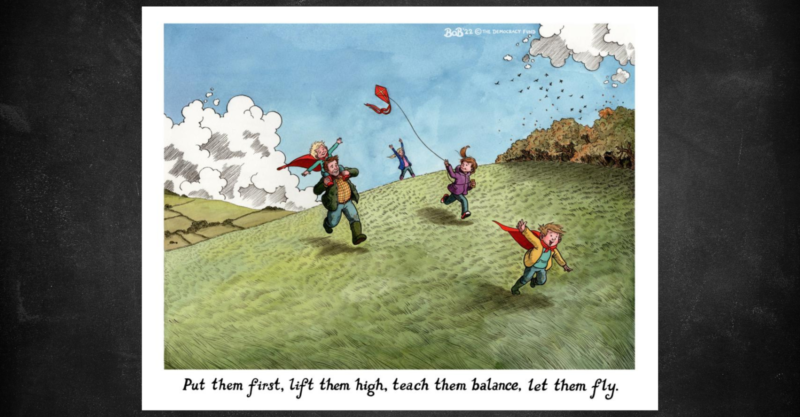
Artwork Credit: Bobmoran.co.uk
AN OVERVIEW OF SCHOOLING’S ORIGINS & EFFECTS
Most parents send their children to school sometime between the ages of 4 and 6 years. How much thought do they give to that decision, one which will have a profound and lasting effect on all aspects of their child’s development and how their child negotiates their life path?
For sure, we become accustomed to ways of doing things and, over time, perhaps no longer question why we do them. As long as life is ‘easy’ and we’re comfortable, many of us become somewhat lazy or acquiescent and are only stimulated to examine the accepted norms of our lives, such as schooling, when some shock or crisis, or a creeping realization that our way of life is harming us in some way, jolts us out of our routine and lethargy.
Many of us also send our children to school because we, perhaps unthinkingly, believe as we have been told, that it is the pathway to material and social success. It prepares them for effective participation in society we think. Is this really the case? What type of participation and, at what cost to our child’s overall development?
A challenging question for any parent is how they weigh up the ‘benefits’ of the standard government pathway – schooling – against their understanding of what is necessary and right for their child to grow up as a confident, free man or woman with a capacity for independent and clear critical thought, confidence in their own ability to navigate life in this world and a moral sense which is learned and imbibed from their families in the first instance, and not a result of conditioning or training, or taught as rules.
When one considers the lives many people are accustomed, if not compelled by circumstances, to live nowadays, with both parents or a lone parent working, deciding on an alternative to conventional schooling can be quite a challenge. Big changes in how we live our lives can be daunting and necessitate risk but, if we strongly feel unhappy about the direction in which life is taking us, we seriously need to examine our options; in the words of Socrates: An unexamined life is not worth living. Life as a free man or woman requires perpetual reflection and examination. In Phenomenology of Spirit, Hegel says:
It is solely by risking life that freedom is obtained; … the individual who has not staked his life may, no doubt, be recognized as a Person; but he has not attained the truth of this recognition as an independent self-consciousness.
In The Underground History of American Education (2006)i, in relation to most peoples’ largely unquestioning acceptance of school as the pathway to adulthood for our children, John Taylor Gatto tells us,
You aren’t compelled to loan your car to anyone who wants it, but you are compelled to surrender your school-age child to strangers who process children for a livelihood, even though one in every nine schoolchildren is terrified of physical harm happening to them in school, terrified with good cause; about thirty three are murdered there every year [from 1992 through 1999, 262 children were murdered in school in the United States]. Your great- grandmother didn’t have to surrender her children. What happened?
If I demanded you give up your television to an anonymous, itinerant repairman who needed work, you’d think I was crazy; If I came with a policeman who forced you to pay that repairman even after he broke your set you would be outraged. Why are you so docile when you give up your child to a government agent called a schoolteacher? (xxiv)
Yet most of us do give our children up to school. It is worth remembering that schooling was not introduced anywhere because someone, or any number of people, wanted to make human life more fulfilling, wanted to make children – future adults – more confident, self reliant and capable free people. The truth is quite the opposite: schooling was introduced in Europe and the U.S. to make people more manageable, more orderly and more effective workers. Schooling was introduced by the powerful – those who believe they have the right to direct how the mass of humanity lives – to minimize any possibility of a threat to their power and wealth from the masses, to provide docile workers and to consolidate their wealth. (We ourselves are products of our schooling.) In Weapons of Mass Instructionii Gatto quotes H.L Mencken, from The American Mercury of April 1924 who says that the aim of public education is not,
… to fill the young of the species with knowledge and awaken their intelligence. … Nothing could be further from the truth. The aim … is simply to reduce as many individuals as possible to the same safe level, to breed and train a standardised citizenry, to put down dissent and originality. That is its aim in the United States … and that is its aim everywhere else (xvi).
Those who desire to manage and control humanity, whatever the cost, have always been a facet of human society, whether we’re talking about ancient kings and emperors or contemporary oligarchs and billionaires, and their government ‘partners.’ These powerful individuals and groups have always wanted to protect and consolidate their power and wealth, and the greatest threat to their efforts, that which they fear the most, comes from their fellow humans. The fellow humans of course are also a resource and since the industrial age and, more intensely since the beginning of the 20th century, the management and appropriate training of workers for the growing factory based economies and, most importantly, consumers for the products of these factories, was also a priority. See here and here. Fear and force have always been used to control the masses and keep workers in their place but, for almost a century now, psychological mind formation and control techniques1 have increasingly been brought into play. The most potent mind control medium for some time has been television though the heavily censored and managed online world is becoming an increasingly serious threat to all of our possibilities for informed free thought. Schooling however, in virtue of its omnipresence – in most jurisdictions school attendance is compulsory – , is the most pernicious, relentless and efficient means of effecting control over the formation and development of our children and young people, and managing the human herd. While the curriculum content and approaches to how reading, writing and arithmetic are taught are increasingly questionable, my focus in this essay is on the hidden curriculum. By the hidden curriculum I mean the structure, rules and process of schools and the lasting effect these have on the developing young person and on how they negotiate their life path.
JOHN TAYLOR GATTO: The Witness
John Taylor Gatto is, without doubt, a peerlesss guide and witness to the negative effects of the hidden curriculum on our young people. Gatto worked as a schoolteacher for 30 years in, as he puts it, “some of the worst schools in Manhattan, and in some of the best, and during that time I became an expert in boredom” (Weapons of Mass Instruction, xiii). His credentials could hardly be more impressive, having been awarded New York City Teacher of the Year in 1989, 1990 and 1991. He was also named New York State Teacher of the Year for 1991 and, in his speech on that occasion, titled The Seven-Lesson Schoolteacher, chapter 1 of Dumbing us Down, The Hidden Curriculum of Compulsory Schoolingiii, he summarises what he teaches that is wrong in seven lessons: Confusion, Class Position, Indifference, Emotional Dependency, Intellectual Dependency, Conditional Self-Esteem and Surveillance. He tells us, “What I do that is right is simple to understand: I get out of kids’ way, I give them space and time and respect. What I do that is wrong, however, is strange, complex, and frightening. Let me begin to show you what that is” (xxxviii).
In lesson 1, Confusion, he says that everything he teaches is out of context – lots of disconnected facts – and points out that human beings seek meaning and natural sequences, not disconnected facts.
I teach the un-relating of everything, an infinite fragmentation the opposite of cohesion; what I do is more related to television programming than to making a scheme of order. In a world where home is only a ghost because both parents work, or because of too many moves or too many job changes or too much ambition, or because something else has left everybody too confused to maintain a family relation, I teach students how to accept confusion as their identity. That’s the first lesson I teach (Dumbing Us Down, 4).
In The Fear Of Freedomiv, first published in 1942, Erich Fromm argues that the freedom enjoyed by modern man “though it has brought him independence and rationality, has made him isolated and, thereby, anxious and powerless” (x). He makes the same point as Gatto with respect to schooling, that an emphasis on facts discourages original thinking thereby reducing if not disabling man’s capacity for apprehending freedom.2
School disrupts children’s natural sense of order and self-cohesion. “[T]he lessons of school prevent children from keeping important appointments with themselves and with their families to learn lessons in self-motivation, perseverance, self-reliance, courage, dignity, and love – and lessons in service to others, too, which are among the key lessons of home and community life” (Ibid., 19). In the lesson, Class Position, Gatto says his job is to ensure children stay in their own social class and get to like it. He says:
If I do my job well, the kids can’t even imagine themselves somewhere else because I’ve shown them how to envy and fear the better classes and how to have contempt for the dumb classes. Under this efficient discipline the class mostly polices itself into good marching order. That’s the real lesson of any rigged competition like school. You come to know your place (Ibid., 4, 5).
Indifference is the third lesson Gatto teaches: “I teach children not to care too much about anything, even though they want to make it appear that they do” (Ibid., 5). I do this, he says,
by demanding that they become totally involved in my lessons, … But when the bell rings I insist they drop whatever it is we have been doing and proceed very quickly to the next work station. They must turn on and off like a light switch. Nothing important is ever finished in my class or in any class I know of. Students never have a complete experience except on the installment plan.
Indeed, the lesson of bells is that no work is worth finishing, so why care too deeply about anything. Years of bells will condition all but the strongest to a world that can no longer offer important work to do (Ibid., 5, 6).
Under Emotional Dependency, Gatto says, “By stars and red checks, smiles and frowns, prizes, honors and disgraces, I teach kids to surrender their will to the predestinated chain of command” (Ibid., 6). He is here describing behavioristic stimulus-response teaching as advocated by Edward Lee Thorndike, and many other adherents to the new educational psychology at the beginning of the 20th century. The most important lesson of them all, Gatto tells us, is Intellectual Dependency:
Good students wait for a teacher to tell them what to do. This is the most important lesson of them all: we must wait for other people, better trained than ourselves, to make the meanings of our lives. … Good people wait for an expert to tell them what to do. It is hardly an exaggeration to say that our entire economy depends upon this lesson being learned. Think of what might fall apart if children weren’t trained to be dependent: social services would hardly survive – they would vanish, I think, into the recent historical limbo out of which they arose. Counselors and therapists would look on in horror as the supply of psychic invalids vanished (Ibid., 8).
The compliance by most people in the ‘developed’ world with the arbitrary, unjustified and criminally unacceptable lockdowns and associated restrictions on their liberty since early 2020 and through the covid period is, I would argue, a profound example of the ‘success’ of schooling.
In Deschooling Societyv, Ivan Illich reiterates the point that the institutions of society, and, profoundly and fundamentally schools, in virtue of being such dominant influences in our lives, contribute significantly to the formation of our world view and our dependence on institutions.
Rich and poor alike depend on schools and hospitals which guide their lives, form their world view, and define for them what is legitimate and what is not. Both view doctoring oneself as irresponsible, learning on one’s own as unreliable, and community organisation, when not paid for by those in authority, as a form of aggression or subversion. For both groups the reliance on institutional treatment renders independent accomplishment suspect (Deschooling Society, 2, 3)
In a section titled, The Myth of Institutionalized Values, Illich points out that,
School initiates, too, the Myth of Unending Consumption. … School teaches us that instruction produces learning. The existence of schools produces the demand for schooling. Once we have learned to need school, all our activities tend to take the shape of client relationships to other specialized institutions. Once the self-taught man or woman has been discredited, all nonprofessional activity is rendered suspect. In school we are taught that valuable learning is the result of attendance; that the value of learning increases with the amount of input; and, finally, that this value can be measured and documented by grades and certificates (Ibid., 38, 39).
While Gatto’s teaching experience has been in secondary school, he also shows the less obvious, though no less insidious, effects of the lessons of confusion, indifference, and emotional and intellectual dependence in elementary school:
Meaning, not disconnected facts, is what sane human beings seek, and education is a set of codes for processing raw data into meaning. Behind the patchwork quilt of school sequences and the school obsession with facts and theories, the age-old human search for meaning lies well concealed. This is harder to see in elementary school where the hierarchy of school experience seems to make better sense because the good-natured simple relationship between “let’s do this” and “let’s do that” is just assumed to mean something and the clientele has not yet consciously discerned how little substance is behind the play and pretense (Dumbing us Down, 3).
The final two lessons Gatto teaches are Provisional Self-Esteemn and that One Can’t Hide. Children’s self respect requires validation by experts. “My kids,” Gatto says, “are constantly evaluated and judged. … The lesson of report cards, grades and tests is that children should not trust themselves or their parents but should instead rely on the evaluation of certified officials. People need to be told what they are worth” (Ibid., 9, 10). The negative rationale for the panopticon-like perpetual surveillance implies that no one can be trusted. “[C]hildren must be closely watched if you want to keep a society under tight central control. Children will follow a private drummer if you can’t get them into a uniformed marching band” (Ibid., 11).
Society in the U.S., Europe and throughout the developed world is largely centrally governed and this makes compulsory, government monopoly schooling easy to implement and enforce. (Gatto’s writings are based on his experiences in the U.S. but his analysis and insights are relevant and applicable throughout the world, including Ireland. Schooling everywhere is, and always has been, about control and management of people and providing the ‘right’ kind of adult for the industrial machine.) Before the civil war, he tells us, schooling wasn’t very important:
People learned to read, write, and do arithmetic just fine anyway; there are some studies that suggest literacy at the time of the American Revolution, at least for non-slaves on the Eastern seaboard, was close to total. Thomas Paine’s Common Sense sold 600,000 copies to a population of 3,000,000, of whom twenty percent were slaves and fifty percent indentured servants (Ibid., 12).
To make the point that the introduction of compulsory schooling had very little to do with personal education, and certainly did not improve literacy, he says:
Our form of compulsory schooling is an invention of the State of Massachusetts around 1850. It was resisted — sometimes with guns — by an estimated eighty percent of the Massachusetts population, the last outpost in Barnstable on Cape Cod not surrendering its children until the 1880s, when the area was seized by militia and children marched to school under guard.
Now here is a curious idea to ponder: Senator Ted Kennedy’s office released a paper not too long ago claiming that prior to compulsory education the state literacy rate was ninety-eight percent and that after it the figure never exceeded ninety-one percent, where it stands in 1990 (Ibid., 22).
The hidden curriculum, that is, the school structure and rules, the effect of the experience of the institution on the student and the monopolization of their time IS the primary purpose and the lasting impact of schooling.
After an adult lifetime spent teaching school, I believe the method of mass schooling is its only real content. Don’t be fooled into thinking that good curriculum or good equipment or good teachers are the critical determinants of your son’s or daughter’s education. All the pathologies we’ve considered come about in large measure because the lessons of school prevent children from keeping important appointments with themselves and with their families to learn lessons in self- motivation, perseverance, self-reliance, courage, dignity, and love — and lessons in service to others, too, which are among the key lessons of home and community life (Ibid., 19) (Bold emphasis added).
How did universal compulsory schooling become the standard ‘rite of passage’ for almost all young people throughout the world? How did such a damaging process become the norm?
ORIGINS OF SCHOOLING: Sociopolitical & Psychological
Almost all contemporary education systems are based on the Prussian education system of the 19th century, the foundations of which were laid down by Prussian philosopher, Johann Gottlieb Fichte (1762-1814), in his Addresses to the German Nation (1808)vi. Fichte wrote his Addresses following the defeat of the Prussian army by Napoleon’s army – which consisted of amateur soldiers – in 1806. This was a serious blow to Prussian/German national pride and was blamed on the soldiers’ lack of discipline in both thought and behaviour. With his ‘new education’ Fichte wanted to restore German pride, to build and consolidate a German nation:
Through the new education we desire to form the Germans into a totality that in all its individual parts is driven and animated by the same single interest [Angelegenheit]. … [T]here is thus nothing we can do save bring the new education to all who are German, without exception, so that it becomes not the education of a particular class but simply of the nation as such, and without exempting a single individual member; (Addresses to the German Nation, 19).
The new Germany required compliant and disciplined soldiers and workers and independent thinkers were not a good fit for the mechanistic and regimented military of the day nor for the factory system. For Fichte, the new education must make the child absolutely subservient to the state:
[T]he new education would consist precisely in this, that, on the soil whose cultivation it takes over, it completely annihilates freedom of will, producing strict necessity in decisions and the impossibility of the opposite in the will, which can now be reckoned and relied on with confidence. … If you wish to have influence over him, then you must do more than merely appeal to him; you must fashion him, fashion him such that he cannot will anything save what you want him to will (Ibid., 23, 24).
The influence of the parents and family must be minimised:
As far as our higher conception of a national education is concerned, however, we are firmly convinced that it can be neither commenced nor continued nor completed in the home, especially among the labouring classes, and indeed without totally separating the children from their parents (Ibid. 123, 124).
The new education would also be compulsory. When voluntary military service was no longer sufficient for the purpose intended, Fichte tells us, it was made compulsory.
[I]n earlier times military service was voluntary; but when it was found that this was insufficient for the purpose intended, there was no hesitation in backing it up with compulsion, because the matter was important enough for us and necessity dictated compulsion. May our eyes be opened to our necessity in this regard also, and the object become likewise important to us; then our qualms would vanish of themselves (Ibid., 147).
In 1810, following the publication of Fichte’s Addresses to the German Nation in 1808, the Prussian minister in charge of education, Karl August von Hartenberg, announced the founding of the world’s first research university, the University of Berlin, dedicated to progress through research, and appointed Fichte dean of the Philosophy Department. In the following year, Fichte was elected rector of the university and began to put his educational program into practice. The new national education spread throughout Prussia through her research universities and, in time, through most of the rest of Europe, eventually influencing education practises throughout the world.
If Fichte laid the broad foundations of Prussian education with his idealism, Wilhelm Wundt gave it serious global impetus with his experimental psychology. Following graduation as a medical doctor from the University of Heidelberg in 1856, Wundt became a professor in the field of psychology. Paolo Lionni tells us that “Psychology, at that time, meant simply the study (ology) of the soul (psyche), or mind” (The Leipzig Connection: The Systematic Destruction of American Educationvii, 1). In 1874 Wundt accepted a chair in philosophy at the University of Leipzig. In 1889 he was appointed rector and remained at Leipzig for the rest of his academic career. Wundt’s approach was empiricist and marked a significant departure from the understanding of psychology as described above. He is generally acknowledged as the father of experimental psychology and founded the world’s first psychology laboratory. “To Wundt, a thing made sense and was worth pursuing if it could be measured, quantified, and scientifically demonstrated. Seeing no way to do this with the human soul, he proposed that psychology concern itself solely with experience” (Lionni, 2). If, as Wundt asserted, “man is devoid of spirit and self-determinism … [then] man is the summation of his experiences, of the stimuli which intrude upon his consciousness and unconsciousness” (Ibid., 7). For Wundt, “the new psychology [was] a study of the brain and the central nervous system” (Ibid., 7, 8). Fichte’s new ‘education’ aimed to crush the child’s will and make him subservient to the ‘master’s’ will: “you must fashion him, fashion him such that he cannot will anything save what you want him to will” (Addresses to the German Nation, 23, 24). Wundt’s experimental psychology now provides a scientific underpinning for achieving this as Lionni describes in graphic detail:
If one assumes (as Wundt did) that there is nothing there to begin with but a body, a brain, and a nervous system, then one must try to educate by inducing sensations in that nervous system. Through these experiences, the individual will learn to respond to any given stimulus, with the “correct” response. The child is not, for example, thought capable of volitional control over his actions, or of deciding whether he will act or not act in a certain way: his actions are thought to be preconditioned and beyond his control, because he is a stimulus-response mechanism. According to this thinking, he is his reactions. Wundt’s thesis laid the philosophical basis for the principles of conditioning later developed by Pavlov (who studied physiology in Leipzig, in 1884, five years after Wundt had inaugurated his laboratory there) and American behavioral psychologists such as Watson and Skinner; for lobotomies and electroconvulsive therapy; for schools oriented more toward the socialization of the child than toward the development of the intellect; and for the emergence of a society more and more blatantly devoted to the gratification of sensory desires at the expense of responsibility and achievement (Lionni, 9).
Wundt’s behaviorist thesis also laid the foundations for the current widespread use of medication – e.g. ritalin – to modify and suppress students’ behavior so that they are docile and compliant in the classroom.
His work ultimately gave rise to a fundamental redefinition of the meaning of education. Charlotte Thompson Iserbyt describes the change:
“The sowing of the seeds: late eighteenth and nineteenth centuries” is the shortest chapter of the deliberate dumbing down of america. Undoubtedly, this chapter may be one of the most important since the philosophies of Jean- Jacques Rousseau, Wilhelm Wundt, and John Dewey et al., reflect a total departure from the traditional definition of education like the one given in The New Century Dictionary of the English Language (Appleton, Century, Crofts: New York, 1927):
The drawing out of a person’s innate talents and abilities by imparting the knowledge of languages, scientific reasoning, history, literature, rhetoric, etc. -the channels through which those abilities would flourish and serve.
A quantum leap was taken from the above definition to the new dehumanising definition used by the experimental psychologists found in An Outline of Educational Psychology (Barnes & Noble: New York, 1934, rev. ed.) by Rudolf Pintner et al. That truly revolutionary definition claims that
learning is the result of modifiability in the paths of neural conduction. Explanations of even such forms of learning as abstractions and generalization demand of the neurones only growth, excitability, conductivity, and modifiability. The mind is the connection-system of man; and learning is the process of connecting. The situation-response formula is adequate to cover learning of any sort, and the really influential factors in learning are readiness of the neurones, sequence in time, belongingness, and satisfying consequences (The Deliberate Dumbing Down of Americaviii, 1).
In The Underground History of American Education, Gatto points out the anti-humanity in Wundt’s experimental psychology: “Coming out of the physiological tradition of psychophysics in Germany, Wundt followed the path of de L Mettrie, Condillac, and Descartes in France who argued, each in his own way, that what we think of as personality is only a collection of physiological facts. Humanity is only an illusion” (279) (Bold emphasis added).
Wundt’s experimental psychology was empirically grounded – it was no longer speculative but was based on observation, experiment and measurement and this new scientific understanding of psychology attracted large numbers of students from Europe and the U.S. Lionni quotes Edna Heidbreder from Seven Psychologies, who points out the power and reach of this new empirically grounded, experimental psychology. Heidbreder says,
It was the psychology for bold young radicals who believed that the ways of the mind could be measured and treated experimentally-and who possibly thought of themselves, in their private reflections, as pioneers on the newest frontiers of science, pushing its method into reaches of experience that it had never before invaded. … And throughout all their endeavours they were dominated by the conception of a psychology that should be scientific as opposed to speculative; always they attempted to rely on exact observation, experimentation, and measurement. Finally when they left Leipzig and worked in laboratories of their own-chiefly in American or German universities-most of them retained enough of the Leipzig impress to teach a psychology that, whatever the subsequent development of the individual’s thought, bore traces of the system which was recognized at Leipzig as orthodox (Lionni, 13, 14).
These Leipzig-educated teachers returned to their home countries and propagated this Wundtian, behaviorist, experimental psychology, training large numbers of Ph.D. students in psychology. In the U.S. almost all of these students became involved in the field of education. The first to return to the U.S. was G. Stanley Hall who would have a major influence on the adoption and development of behaviorist experimental psychology and its effect on the practise of education in the U.S. John Dewey, probably the greatest influence on American education, studied under Hall for a year and in 1887, while a professor at Michigan university, Dewey published Psychology which was the first American textbook on the “revised” subject of education and would become the most widely read and referenced textbook used in schools of education throughout the U.S.
In 1895, Dewey was invited to join the faculty of the Rockefeller-endowed University of Chicago as head of the combined departments of philosophy, psychology and pedagogy, the same year the university allocated $1000 for the establishment of an educational laboratory. The laboratory, known as the Dewey School, opened in January 1896, later becoming known as the Laboratory School of the University of Chicago. In the school Dewey’s theories of education would be put into practice, tested and scientifically evaluated. Lionni tells us:
Although today Dewey’s views are in practice in the great majority of American schools, before the turn of the century they were revolutionary. The Wundtian redefinition of “education” to mean feeding experiential data to a young brain and nervous system, rather than the teaching of mental skills, led to the abdication of the traditional role of the teacher as educator. Its place was taken by the concept of the teacher as a guide in the socialization of the child, leading each youngster to adapt to the specific behavior required of him in order for him to get along in his group. Dewey called for a levelling of individual differences into a common pool of students who are the object of learning technicians devising the social order of the future (18,19) (my bold emphasis).
This point is emphasised by Charlotte Thompson Isderbyt who quotes Dennis L. Cuddy, Ph.D. from an excellent article entitled “The Conditioning of America” (The Christian News, New Haven, Mo., December 11, 1989). In Cuddy’s words:
The conditioning of modern American society began with John Dewey, a psychologist, a Fabian Socialist and the “Father of Progressive Education.” Dewey used the psychology developed in Leipzig by Wilhelm Wundt, and believed that through a stimulus-response approach (like Pavlov) students could be conditioned for a new social order (Cuddy, as quoted by Iserbyt, 3).
While Dewey is known as the father of American education, there were many other practitioners of Wundt’s “new” psychology who left a lasting imprint on American education and, consequently, American life. While many of these practitioners are worthy of note, the views and approach to education of Edward Lee Thorndike are particularly chilling. Thorndike was trained by the first generation of Wundtians. Lionni tells us Thorndike “was the first psychologist to study animal behaviour in an experimental psychology laboratory and (following Cattell’s3suggestion) apply the same techniques to children and youths; as one result, in 1903 he published the book Educational Psychology” (31, 32). Like Wundt, for Thorndike man is an animal whose actions are always reactions.
Thorndike equated children with the rats, monkeys, fish, cats and chickens upon which he experimented in his laboratory and was prepared to apply what he found there to learning in the classroom. He extrapolated “laws” from his research into animal behavior which he then applied to the training of teachers, who took what they had learned to every corner of the United States and ran their classrooms, curricula, and schools on the basis of this new “educational” psychology (Ibid., 32).
Thorndike’s definition of teaching from The Principles of Teaching based on Psychology (1906) is noteworthy:
… the art of giving and witholding stimuli with the result of producing or preventing certain responses. In this definition the term stimulus is used widely for any event which influences a person, – for a word spoken to him, a look, a sentence which he reads, the air he breathes, etc., etc. The term response is used for any reaction made by him, – a new thought, a feeling of interest, a bodily act, any mental or bodily condition resulting from the stimulus. The aim of the teacher is to produce desirable and prevent undesirable changes in human beings by producing and preventing certain responses. The means at the disposal of the teacher are the stimuli which can be brought to bear upon the pupil, – the teacher’s words, gestures, and appearance, the condition and appliances of the school room, the books to be used and objects to be seen, and so on through a long list of the things and events which the teacher can control (Ibid., 32, 33).
This behavioristic stimulus-response style of teaching has contributed hugely to the creation of a society of consumers rather than producers. It also contributes to societal moral decay or, at least, militates against the possibilities for a morally based society, favouring gratification over reason or responsibility as a motivator of behaviour. Children learn in school that what is pleasurable is good and what isn’t pleasurable is not good. The notion of good behaviour being its own reward no longer applies when the child has been reduced to a stimulus/response, pleasure-seeking organism.
Obedient consumers, not producers, were exactly what industrialists and business people wanted at the turn of the century – still today. Educated just enough so that they would make perfect consumers but not quite enough to become effective producers. Industrialists and financiers, in particular Rockefeller and Carnegie, dominated education and between 1896 and 1920 spent more money on forced schooling than the government. They had clearly identified compulsory schooling as the means to format the young to suit their business interests and ‘needs.’ Gatto references a 1906 document titled Occasional Letter Number One from Rockefeller’s General Education Board:
In our dreams … people yield themselves with perfect docility to our molding hands. The present educational conventions [of intellectual and moral education] fade from our minds, and unhampered by tradition we work our own good will upon a grateful and responsive folk. We shall not try to make these people or any of their children into philosophers or mean of learning or men of science. We have not to raise up from among them authors, educators, poets, or men of letters. We shall not search for embryo great artists, painters, musicians, nor lawyers, doctors, preachers, politicians, statesmen – of whom we have an ample supply. The task we set before ourselves is very simple … we will organize children … and teach them to do in a perfect way the things their fathers and mothers are doing in an imperfect way.
In other words, they didn’t want brains or talent, just obedience (Weapons of Mass Instruction, 8).
Contrasting colonial and early federal America with with corporate-capitalist America, Gatto says that early America
held the ideal of self-sufficiency as the very pinnacle of achievement. The ideal household aimed to produce its own food, clothing, shelter, entertainment, transportation, medical care, education, child care, and social security. … Were that vision to have been maintained through forced schooling it would have destroyed corporations in embryo. Overproduction would have strangled capital accumulation by posing continuous competition – and without capital accumulation, no dominant corporations. Far from production as an ideal, it was consumption that had to be encouraged (Weapons of Mass Instruction, 44).
This was America at the beginning of the 20th century and, while each country, including Ireland, will have implemented Prussian originated, behaviourist education systems to a greater or lesser degree relative to their own culture and history, they will all be based on this model. That is, the hidden curriculum and how the entire schooling experience and a tailored curriculum are responsive to the requirements of powerful financial/business interests and the state, training and preparing our children for lives as consumers. We can choose otherwise: to live our lives as the divinely inspired, free people we are and to rear and educate our children to maximize their possibilities for divinely inspired, free, productive and fulfilling lives.
If the foregoing has unsettled you or encouraged you to reconsider your options around your child’s education, homeschooling may be an option. More importantly, if you harbour any concerns that without schooling your child might find it difficult to engage effectively with the world and achieve what they want in life, take heart from the wise words of John Taylor Gatto and Charlotte Thompson Iserbyt.
Gatto tells us that “reading, writing, and arithmetic only take about one hundred hours to transmit as long as the audience is eager and willing to learn. The trick is to wait until someone asks and then to move fast while the mood is on” (Dumbing Us Down, 12).
Charlotte Thompson Iserbyt says:
1) If a child can read, write and compute at a reasonably proficient level, he will be able to do just about anything he wishes, enabling him to control his destiny to the extent that God allows (remain free);
2) Providing such basic educational proficiencies is not and should not be an expensive proposition (Iserbyt, The Dumbing Down of America, xiii).
For many families, homeschooling makes a lot of sense but is simply not practically possible; the life changes, confidence and indeed courage required to commit make it too daunting a possibility. If you cannot homeschool right now, deepening your understanding of the origins, effects and consequences of the schooling system can only add to your confidence and strength such that you will be a more informed, wiser and more supportive parent.
In our own lives and in our hopes and intentions for our children in their lives we are challenged to choose somewhere on the scale between freedom and fear, reasonable risk over security and safety. The isolation, anxiousness and powerlessness Erich Fromm refers to (See footnote 2,) can impel us to security and a ‘safe’ life. How we choose determines the degree to which we are truly alive. We can choose “either to escape from the burden of this freedom into new dependencies and submission, or to advance to the full realization of positive freedom which is based upon the uniqueness and individuality of man” (Fromm, The Fear Of Freedom, x).
As adults, if we have niggling yearnings for freedom, we have the power to overcome the fear that impels us towards security and safety; it is never too late to express our freedom, to ‘be’ that truly free person that calls to us.
With respect to our children, the challenge is multiplied; even if we are personally willing to risk life for our freedom, for a richer and fuller life, choosing freedom over perceived security for our children’s lives takes more confidence and strength of conviction. We, of course, want our children to have good, trouble-free and materially secure lives but we also, naturally, want them to become their best selves and to feel truly free. How we engage with and deal with this question is uniquely personal for each of us and is obviously influenced by the circumstances and challenges each of us face in our lives. What is important is that we understand the importance and value of freedom for a lived and truly human life. How we act thereafter is up to us.
A Small Selection of Resources
Today, early 2026, there is a wealth of resources on home education and unschooling. The following is a small selection which I have found inspiring.
Aside from his books, there are many interviews with John Taylor Gatto on youtube.com and bitchute.com. Here are two links to a long interview Gatto did with Richard Grove which includes a 17 minute introduction by Grove: https://www.youtube.com/watch?v=28uPtl5sWVI and https://www.bitchute.com/video/kxTrcauC1yCQ.
There is much of interest on this site, https://deliberatedumbingdown.com/ddd, some of which is not associated with Charlotte Thompson Iserbyt.
John Holt was an inspired advocate for homes education and unschooling. His work addresses many of the concerns of would-be home educators and unschoolers with much material gleaned from conversations with home educators. In Teach Your Own, for example, he addresses many of the common questions and concerns of would be home educators. In 1977, he founded the magazine Growing Without Schooling. https://www.johnholtgws.com is a reasonably comprehensive resource.
Another site with worthwhile resources is https://thenewamerican.com. The following two links are a good introduction: https://thenewamerican.com/tag/homeschooling and https://thenewamerican.com/video/the-facts-on-homeschooling-it-works-really-well-dr-brian-ray.
The book, The Preparation by Doug Casey, Matt Smith and Maxim Smith is essentially a manual for young men on how to live their lives.
In chapter 1 Matt Smith tells us the book is “a father’s best effort to prepare his son (Maxim, age 18) for an important and uncertain time. … We formulated a structure for young men like my son to become competent, confident and dangerous. The philosophical ideas along with exactly how to make it happen. Hopefully this gives you a way to visualize a plan to maximize your time, energy, and money to become the man you want to be” (27).
The following is taken from the ‘about’ page on the accompanying on https://www.thepreparation.com and is obviously aimed at young men.
About The Preparation
For most young men today, the path seems set: go to college, join the military, or settle for a dead-end job. College sits at the top of that list—marketed as the gateway to success. But the reality is different. For many, it’s four uninspired years that end with little more than debt and uncertainty.
The Preparation was born from a different question: what would truly prepare a young man for life?
In this interview, https://geopoliticsandempire.substack.com/p/matt-smith-the-preparation-or-how Matt Smith, one of the authors, has said there are plans in place for a companion book for young women.
1An excellent film on mind control, propaganda and the use of psychological techniques to manipulate and control the masses is The Century of the Self by Alan Curtis.
2As per the title, The Fear Of Freedom, Fromm’s stated thesis is “that modern man, freed from the bonds of pre-individualistic society, which simultaneously gave him security and limited him, has not gained freedom in the positive sense of the realization of his individual self; that is, the expression of his intellectual, emotional and sensuous potentialities. Freedom, though it has brought him independence and rationality, has made him isolated and, thereby, anxious and powerless. This isolation is unbearable and the alternatives he is confronted with are either to escape from the burden of this freedom into new dependencies and submission, or to advance to the full realization of positive freedom which is based upon the uniqueness and individuality of man” (x). As with schools today, the school system in Fromm’s day limited man’s possibilities for realizing positive freedom by effectively discouraging original thinking. Fromm tells us one of the “educational methods used today [The Fear Of Freedom was written in 1942] which in effect … discourage[s] original thinking … is the emphasis on knowledge of facts, or I should rather say on information. The pathetic superstition prevails that by knowing more and more facts one arrives at knowledge of reality. Hundreds of scattered and unrelated facts are dumped into the heads of students; their time and energy are taken up by learning more and more facts so that there is little left for thinking” (The Fear Of Freedom, 213, 214).
3Lionni: “While G. Stanley Hall had been Wundt’s first American student, his compatriot James Mc-Keen Cattell had the distinction of being Wundt’s first assistant and, later, the most effective publicist and promoter of the revised psychology” (21).
iGatto, John Taylor. The Underground History of American Education. Revised edition. New York: The Oxford Village Press, 2006.
iiGatto, John Taylor. Weapons of Mass Instruction. Gabriola Island, BC: New Society Publishers, 2009.
iiiGatto, John Taylor. Dumbing us Down, The Hidden Curriculum of Compulsory Schooling. Introd. David Albert. Gabriola Island, BC: New Society Publishers, 1992.
ivFromm, Erich. The Fear Of Freedom. London: Routledge, 1997.
vIllich, Ivan. Deschooling Society. London: Calder and Boyars Ltd., 1971.
viFichte, Johann Gottlieb. Addresses to the German Nation, Ed. & Introd. Gregory Moore. Cambridge: Cambridge University Press, 2008.
viiLionni, Paulo. The Leipzig Connection, The Systematic Destruction of American Education. Sheridan, Oregon: Heron Books, 1980.
viiiIserbyt, Charlotte Thompson. The Deliberate Dumbing Down of America, A Chronological Paper Trail. Ravenna, Ohio: Conscience Press, 1999.
© 2026, Donagh Healy